
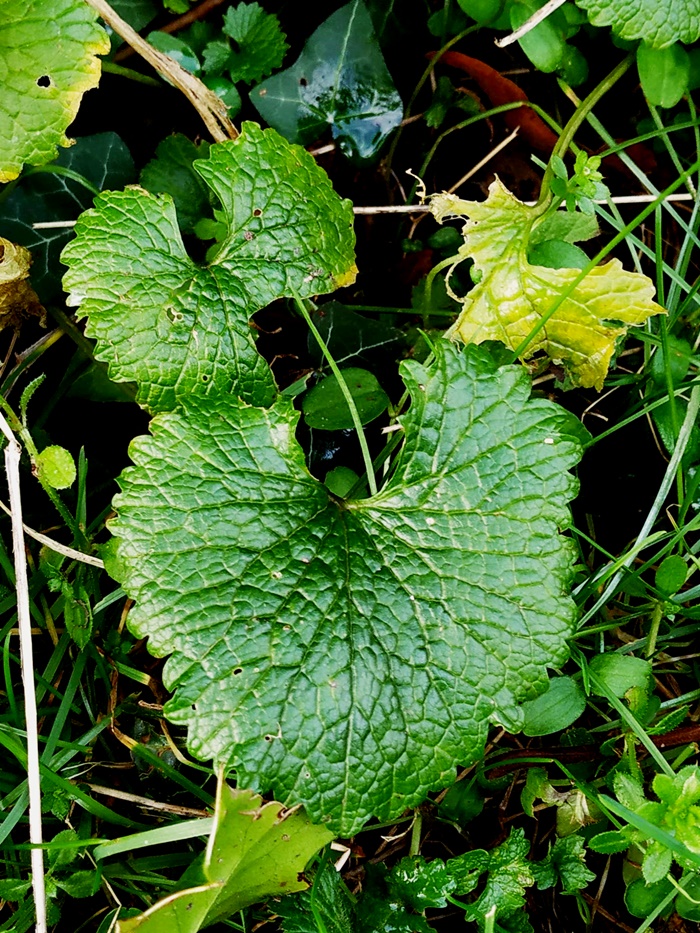
Garlic mustard, also known as Jack-by-the-hedge is a very common little plant growing on the sides of woodland paths and roads. It prefers shady conditions and can be found as early as February and as late as March, depending on which part of the country you live in.
Identification:
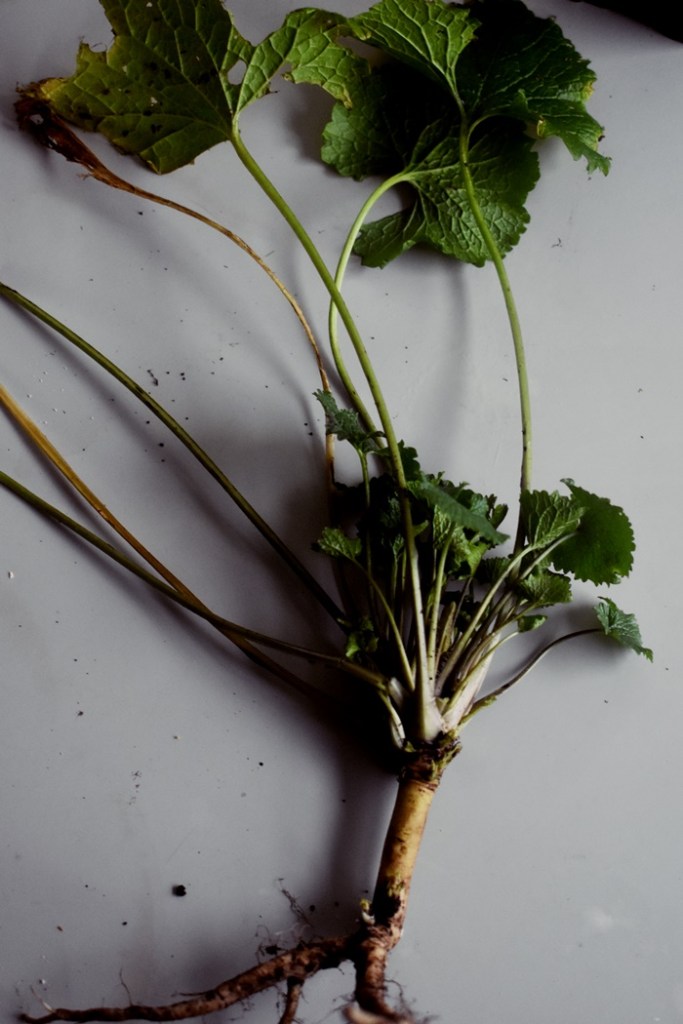
Garlic mustard grows from a basal rosette with rounder leaves towards the bottom and pointier towards the top of the flower stalk. The leaves look somewhat like lesser celandine but the latter has white patches which distinguishes it easily. Garlic mustard has a pungent aroma as it is a member of the mustard family and it is very common in the UK. Note that as the plant grows and starts to flower, the leaves nearest to the top become pointier.
The whole plant is edible and there are several ways you can prepare it. Check out these recipes for garlic mustard pesto and garlic mustard horseradish substitute.
Traditionally, garlic mustard was used as a substitute for garlic (Allium sativum) particularly in cooking, but also medicinally. Garlic mustard was supposed to cure sore gums and throats as well as mouth ulcers and even rubbed on feet to help with cramps (!)
According to PFAF ,”Garlic mustard has been little used in herbal medicine[268]. The leaves and stems are antiasthmatic, antiscorbutic, antiseptic, deobstruent, diaphoretic, vermifuge and vulnerary[4, 7]. The leaves have been taken internally to promote sweating and to treat bronchitis, asthma and eczema[4]. Externally, they have been used as an antiseptic poultice on ulcers etc[4], and are effective in relieving the itching caused by bites and stings[244]. The leaves and stems are harvested before the plant comes into flower and they can be dried for later use[238]. The roots are chopped up small and then heated in oil to make an ointment to rub on the chest in order to bring relief from bronchitis[245]. The juice of the plant has an inhibitory effect on Bacillus pyocyaneum and on gram-negative bacteria of the typhoid-paratyphoid-enteritis group[240]. The seeds have been used as a snuff to excite sneezing[4].””
 (Fer)mental Greens