

One of the first signs that spring is on its way is the appearance of Dandelion, aka blowball, cankerwort, doon-head-clock, witch’s gowan, milk witch, lion’s-tooth, yellow-gowan, Irish daisy, monks-head, priest’s-crown, puff-ball faceclock, pee-a-bed, wet-a-bed, swine’s snout, white endive, and wild endive.
Identification
A nightmare for most gardeners, it grows everywhere, even in tiny cracks on the road tarmac. It is characterised by the “toothed” appearance of its leaves and its name comes from there as well (Dande lion- lion’s tooth). Another characteristic is the bright yellow flower that turns into fluffy seedheads that use the wind to disperse their seeds.
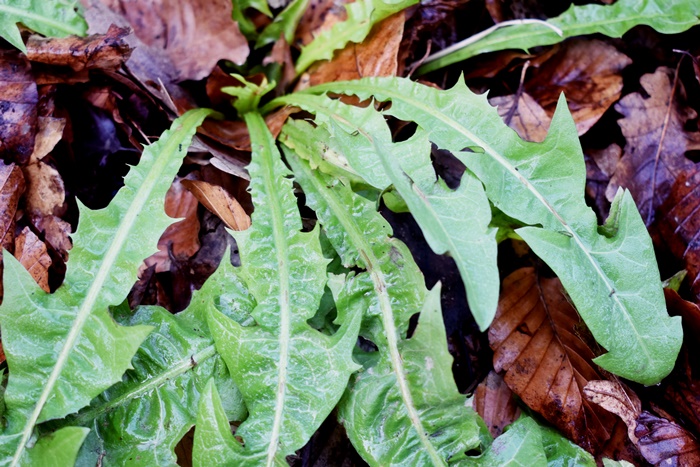
Dandelions have been used by humans for food and as an herb for much of recorded history. They were well known to ancient Egyptians, Greeks and Romans, and are recorded to have been used in traditional Chinese medicine for over a thousand years. The plant was used as food and medicine by Native Americans.
Medicinal properties
According to PFAF “The dandelion is a commonly used herbal remedy. It is especially effective and valuable as a diuretic because it contains high levels of potassium salts and therefore can replace the potassium that is lost from the body when diuretics are used. All parts of the plant, but especially the root, are slightly aperient, cholagogue, depurative, strongly diuretic, hepatic, laxative, stomachic and tonic…The roots can be used fresh or dried and should be harvested in the autumn when 2 years old. The leaves are harvested in the spring when the plant is in flower and can be dried for later use. A tea can be made from the leaves or, more commonly, from the roots. The plant is used internally in the treatment of gall bladder and urinary disorders, gallstones, jaundice, cirrhosis, dyspepsia with constipation, oedema associated with high blood pressure and heart weakness, chronic joint and skin complaints, gout, eczema and acne. The plant has an antibacterial action, inhibiting the growth of Staphylococcus aureus, Pneumococci, Meningococci, Bacillus dysenteriae, B. typhi, C. diphtheriae, Proteus etc. The latex contained in the plant sap can be used to remove corns, warts and verrucae. A tea made from the leaves is laxative. “
Folklore
In folklore the dandelion got its nickname, the ‘shepherd’s clock’, because the flower opens after sunrise and closes in the evening. They are also supposed to bring good luck to a newly married couple when used in a bridal bouquet, and dreaming of dandelions is a sign of bad luck. In some places they are even believed to be protective of witchcraft.
Culinary uses
The whole plant is edible. from the tough fibrous roots to the leaves and lastly the flowerheads. The roots when roasted can serve as a coffee substitute. The leaves, although bitter, serve well in salads, stews and pies. Out of the flowerheads you can make honey, jam and wine.
What are some of your favorite recipes with this amazing little plant?
 (Fer)mental Greens
One thought on “Dandelion- Taraxacum officinale”