
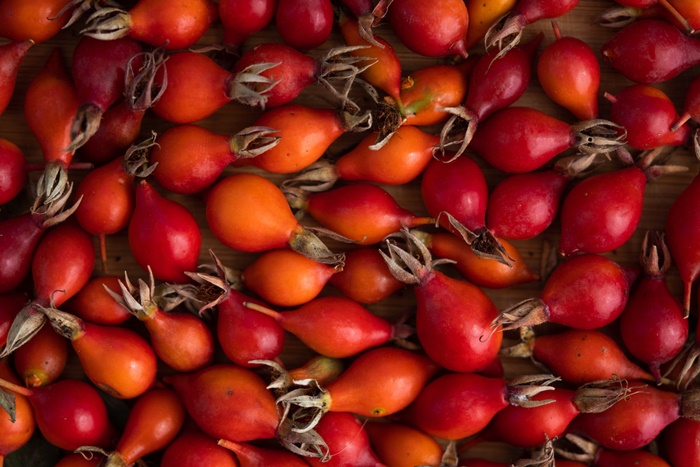
Today’s foraging walk was a bit of a failure. I wanted to do some coastal foraging close to the Lune river estuary but getting lost (for the 10th time since I got to Lancaster) and the threat of rain cut that walk a bit short.
I did however find something to forage- rosehips.
Rosehips are the fruiting bodies of roses and contain many little furry seeds inside them. Ranging from red to orange and even black in some species, they can be found from autumn until the beginning of spring.
Some pick the rosehips as soon as they appear, but if you are planning to eat them, it is best to pick them after a few frosts, when they become wrinkly and mushy as their sugar concentration is at its highest at that stage. They are not toxic raw, they are however unpalatable.
Identification
Rosehips are unmistakable. In early autumn they are accompanied by the characteristic, slightly serrated foliage of roses and they are oval shaped, colorful and have what I call whiskers on their far end side (I am sure there is a botanical word for it).

According to PFAF “the petals, hips and galls are astringent, carminative, diuretic, laxative, ophthalmic and tonic. The hips are taken internally in the treatment of colds, influenza, minor infectious diseases, scurvy, diarrhoea and gastritis. A syrup made from the hips is used as a pleasant flavouring in medicines and is added to cough mixtures. A distilled water made from the plant is slightly astringent and is used as a lotion for delicate skins. The seeds have been used as a vermifuge. The plant is used in Bach flower remedies. The fruit of many members of this genus is a very rich source of vitamins and minerals, especially in vitamins A, C and E, flavanoids and other bio-active compounds. It is also a fairly good source of essential fatty acids, which is fairly unusual for a fruit. It is being investigated as a food that is capable of reducing the incidence of cancer and also as a means of halting or reversing the growth of cancers.”
Rosehips are said to also have anti-ageing and anti-inflammatory (arthritis) properties, help with weight loss and improve heart health, but more research is needed.
History and Folklore
Rosehip seeds were found in what remained of a 2000-year-old body in England so it is thought they were eaten all the way back then. In WWII in England, around 500 tonnes of rosehips were processed into syrups and jams to give a Vitamin C boost to the immune systems of children since citrus was low in supply.
According to folklore, roses and rosehips are symbols of love and one folk tale tells us that rosehips and rose petals were put in a handkerchief and tied three times with a red ribbon. The interested woman would then carry the bundle with her on a Friday and attract her love. Sleeping with rosehips under your pillow is also thought to protect against bad dreams.
Edible uses
There are many things one can do with rose petals, leaves and rosehips, from beauty products, to fruit leathers, spreads, sauces, syrups and jams.
Check out this rosehip with hawthorn vinegar preserve and give it a try 🙂
Sources
 (Fer)mental Greens