
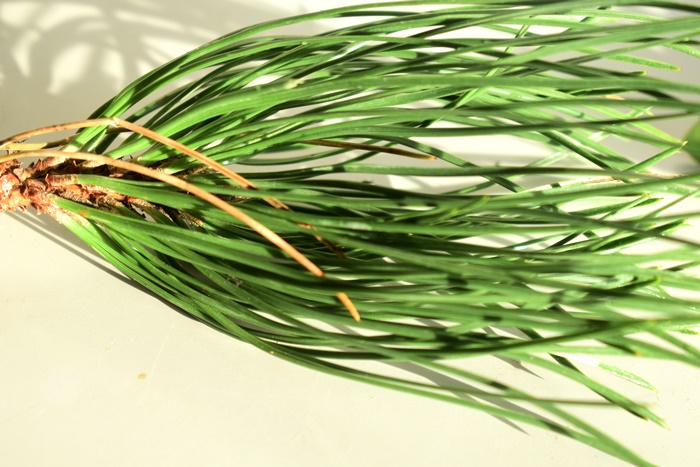
Today’s foraged ingredient is a single spring of scotch pine.
Scotch pine grows prolifically in the UK and the needles are characterised by the fact that two of them grow together in the same bundle.
Conifer foraging in the UK is relatively straightforward. Make sure to stay well away from yew (Taxus baccata) which is very toxic with the only exception being the red “berries”. You also want to avoid cypresses. But other than that all conifers are edible. That includes pines, firs and spruces.
The best time of the year to forage conifers is in spring when you can take the light green, fresh growth and make a myriad of things from it.
Medicinal
Scot’s pine has strong antiseptic action and it is said to help with breathing problems when boiling water is infused with the plant and used for inhalations. According to PFAF, “the turpentine obtained from the resin is antirheumatic, antiseptic, balsamic, diuretic, expectorant, rubefacient and vermifuge.” Scot’s pine is good for bladder infections as well as afflictions of the mucuous membranes. The leaves and young shoots are antiseptic, diuretic and expectorant. The needles can be added to bath water for treating fatigue, nervous exhaustion, sleeplessness, skin irritations.
Industrial
A vanillin flavouring is obtained as a by-product of other resins that are released from the pulpwood. The needles can also produce a green dye, while the cones can produce a yellow dye. “The wooden tissue can produce resin and turpentine. An essential oil obtained from the leaves is used in perfumery and medicinally. A fibre from the inner bark is used to make ropes. The roots are very resinous and burn well. They can be used as a candle substitute. The leaves are used as a packing material. The fibrous material is stripped out of the leaves and is used to fill pillows, cushions and as a packing material. Wood is light, soft, not strong, elastic, durable, rich in resin. Used in construction, furniture, paper manufacture etc.
Folklore
In the past it was said that you shouldn’t fell pine trees under a waning moon. At the winter solstice, the druids would light bonfires of Scots pine branches, with the aim of drawing back the sun into the cycle of seasons.
“In the open country, a farmer who wanted to let the [cattle] drovers know that he was able to provide food, accommodation and grazing planted three Scots pines. These were visible at a great distance, and the drovers used them as way marks. These trees remain when all traces of the old inns or farms have disappeared, the stones having been used for other buildings.”
Fay Godwin and Shirley Toulson, ‘The Drovers’ Roads of Wales’
In ancient Egypt an image of Osiris was burried in a pine tree. Pine, maybe because of its cones that are full of seeds, was a fertility symbon in ancient times. It is said that worshippers of Dionysus carried with them phallic-looking cones on a stick.
As an evergreen tree the pine also symbolised immortality.
“Pine candles were also part of wedding rituals in Scottish fishing communities. The belief was that they brought prosperity and luck to the newly-weds. On Orkney people would circle a pine candle three times around a mother and her newborn child to purify them.”
Culinary uses
Almost the whole plant has culinary uses. The resin is highly aromatic and can be used in water and syrups. The needles can be ried and made into a spice that can be used in a similar way to rosemary. The pollen can be added to baked goods although the taste isn’t particularly strong. Finally the cambium (inner part of the bark) can be made into a flour and used in baking, however this would kill the tree so it should only be harvested from trees that are cut down for other reasons.
Sources:
 (Fer)mental Greens