
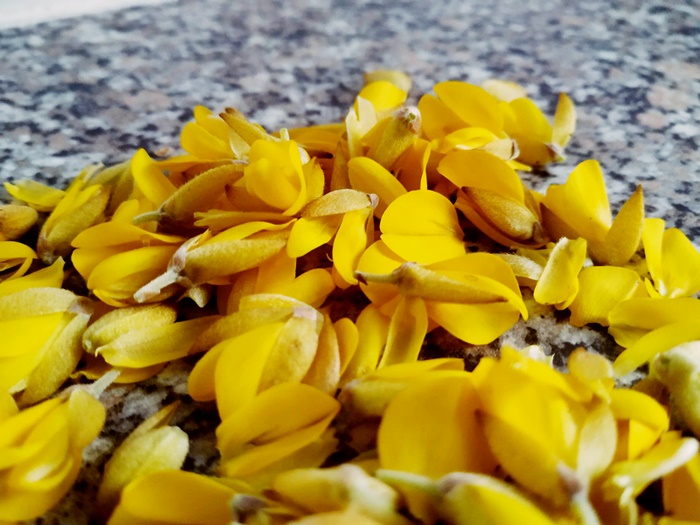
On today’s foraging walk I was welcomed by the beautiful splashes of bright yellow against the backdrop of the cloudy grey sky in Morecambe bay.
Gorse, also known as Ulex europae, broom, whin, ruffet and frey, was to thank for this, as it grows prolifically across the coast there.
Characterised by a dull green color, spiky thorny branches and beautiful flowers with a delicate coconut aroma, it is really difficult to confuse with anything else. Gorse usually flowers January to June.
Some interesting facts about gorse include its “love” for fire. Indeed, gorse grows well in areas where there are fires as usually if no fire is present, taller trees shade it and it cannot grow anymore. Its roots can spring from its burned stumps, and as a highly flammable bush, it was used to fire bread ovens.
Uses
Gorse is also a great plant for soil rehabilitation, as it is part of the legumes family and has nitrogen fixing abilities. It prepares the soil for other species to thrive.
Gorse wood is non-toxic and can be used to build outdoors furniture as it is resistant to rot.
Due to it being spiked and its impenetrable foliage, it is used as a barrier to keep livestock in their fields, and predators out. It also provides a safe sheltered home for other wildlife.
Cows that eat gorse flowers are said to give a higher quality milk.
Gorse ashes are an excellent fertiliser but also highly alkaline which is why they can be mixed with a vegetable oil to make soap.
Folklore
In Celtic mythology Gorse was thought to provide protection against misfortune and was associated with resilience, optimism, and with the Sun, light, and fire. For these reasons gorse was used to light the Beltane fires. “In Irish custom, a twig of Gorse was often hung in dwellings, or worn on clothing. It was thought that like the Gorse tree, wearing a twig would help you overcome any adversity.” In the ogham alphabet gorse (furze) represents the letter O.

In folk medicine, it was used to treat coughs and sore throats and hiccups and to cure worms in horses.
Culinary uses
Gorse flowers have a very delicate coconut aroma and have been used in beer and wine making as well as for whiskey. You can also make a floral cordial out of them. Check out this recipe for a simple gorse syrup and this one for a gorse vinegar.
 (Fer)mental Greens