
Yesterday was not a day for foraging. I had promised my partner that I would help him administer a University event he was hosting and I was there from 9 am until 7 pm. In a small crowded room. Full of incredibly smart people playing slow strategy games. I only lasted 3 hours of this before I had had enough and needed to get out to get some fresh air.
I realised then how much being outdoors and foraging is part of who I am. I can’t stay inside for long periods of time, I can’t keep still and if I don’t find something to forage, I consider it a wasted day.
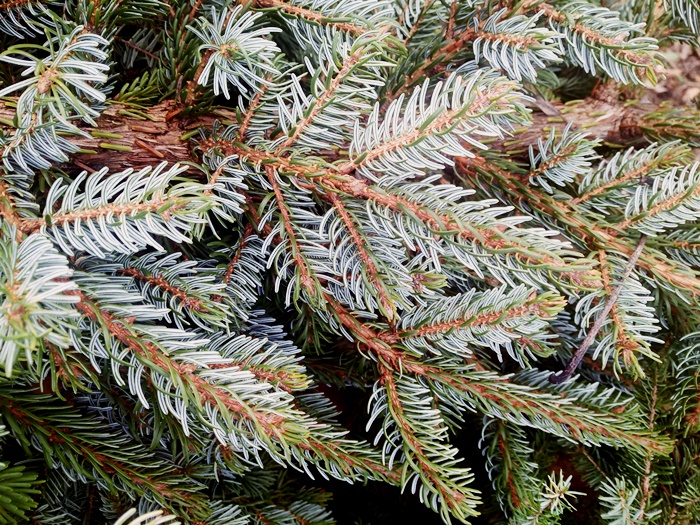
So walking round the university campus I was really excited to find a whole spruce tree!
It was cut down and just laying on the university grass so I knew it was my chance to get some foraging in for the day.
First things first- identification
- Spruce can be confused with fir but if you look closely enough you will see that the needles are distinctive between the two species.
- Spruce needles are four sided, short and attached on the main branch through a wooden attachment like in the picture below. The needles can be rolled between your fingers unlike fir.
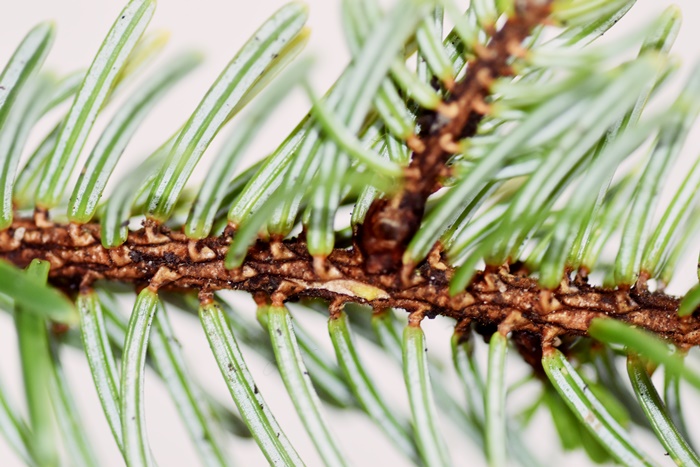
- Fir needles are flatter, they have a distinctive green midrib under the needle enclosed by two parallel silver lines, the needles are attached on the main branch though suction cups and the needles can’t be rolled between your fingers.
All the above being said, both species are edible so what you really need to be careful of is not to confuse with with the toxic Yew (Taxus baccata) that is very distinctive and easy to identify.
Spruces are large trees and most species grow to the height of 20 to 60 meters (60 to 200 feet). Most spruces live up to 150-200 years although a 9.550 years old spruce has been found in Norway.
Each spruce tree carries male and female cones. The pollen from the male cones travels on the breeze to fertilize the egg cells in the female cones.
Spruce is useful as a building wood, in fact the first aircraft to ever be built was built out of spruce! It is also a very common material for musical instruments such as guitars and cellos. The bark is also used to make paper.
The fresh shoots of many spruces are a natural source of vitamin C.
Native Americans in North America use the thin, pliable roots of some species for weaving baskets and for sewing together pieces of birch bark for canoes.
Folklore
Native Americans believed that spruces are “symbols of the sky and directional guardians of the north. According to Hopi myth, the spruce tree was once a medicine man, Salavi, who transformed himself into a tree. For this reason, spruce trees are considered particularly sacred to the Hopis, who use spruce boughs to adorn kachina dancers.”
In Greek mythology, the Spruce tree was dedicated to Artemis, the Goddess of the Moon, Hunting, Nature and protector of women.
Since then, the Spruce tree has also been linked to the birth of Jesus by Christians – a tradition that so many others started by Pagans that brought whole spruce trees into their homes on Winter Solstice to celebrate the life and light following the winter months.
Medicinal
According to PFAF “The buds, leaves and resin are antibiotic, antiseptic, balsamic, expectorant, sedative[7]. A pitch, or resin, obtained from the trunk is rubefacient and stimulant[240]. It is used externally in plasters etc for its healing and antiseptic properties[7]. A poultice of the sap or gum has been used in the treatment of boil and abscess pain[257].”
Culinary
The needles have an acidic citrusy flavour with the characteristic foresty smell of evergreens. Captain Cook made alcoholic sugar-based spruce beer during his sea voyages in order to prevent scurvy (a disease resulting from a lack of vitamin C) in his crew as the needles are a rich source of vitamin C. A beer can be made from the tips and branches, the needles can be made into a syrup or even dried whole so that they can be used like a condiment instead of rosemary.
 (Fer)mental Greens