

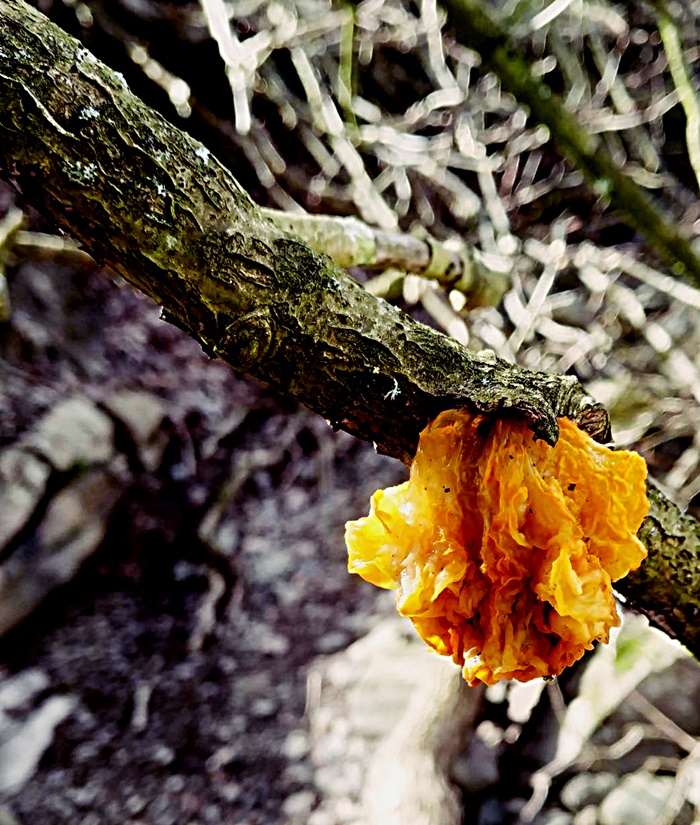
My theory is that every time I go outside foraging here in the Lancashire region, I find something new to write about. Although my facebook and instagram are brimming with other people’s posts on wild garlic finds and recipes, I was really excited to find this little fungus on my walk in Arnside the other day- Witch’s butter AKA Tremella mesenterica
Identification:
First things first- etymology. The name Tremella mesenterica comes from the Latin Tremella which means to tremble, and the Greek mesenterica which means medium intestine. So trembling medium intestine, how’s that for a descriptive name?
Some people say it looks like trembling intestines, others like a brain and the most imaginative among us believe it looks like butter because of its jelly like appearance.
Whatever it looks like to you, you can rest assured that what you have in your hands is Tremella mesenterica if it grows on dead deciduous wood. There is another fungus called Dacrymyces palmatus that looks a lot like this one, but it grows on dead or dying conifers. Whichever you happen to find is fine as they are both edible (some caution should be taken when foraging these off of toxic trees such as yew). There are no toxic lookalikes. The fungus can dehydrate to an amber color and rehydrate when brought in contact with water.
Medicinal
The fungus is said to have antitumor properties as well as be a good medicine for respiratory illness. The latter could be because of the cooling effect it has on the tip of the tongue, a bit like menthol. Other uses of the fungus could be as immunostimulatory, antidiabetic, anti-nflammatory, hypocholesterolemic, hepatoprotective, and antiallergic .
Folklore
In Sweden it is said that witches would steal milk from the cows and as they were leaving they would drop witch’s butter on the ground. It was also said that if the fungus appeared on your doorcase, a bad spell was put upon you and your home and the only way to rid of it would be stabbing the fungus until it dehydrates (too bad it rehydrates quickly!)
Culinary
The fungus is edible and some say it is even edible raw, although as a rule of thumb all wild mushrooms should be cooked prior to eating. Although it is edible, that doesn’t mean it is worth it. There is very little taste on these fungi and not worth the harvest. That being said, it can become an interesting ingredient texturally in soups and stews and is sold in Asian markets in its dehydrated form.
Can you think of any good recipes with witch’s butter?
 (Fer)mental Greens