
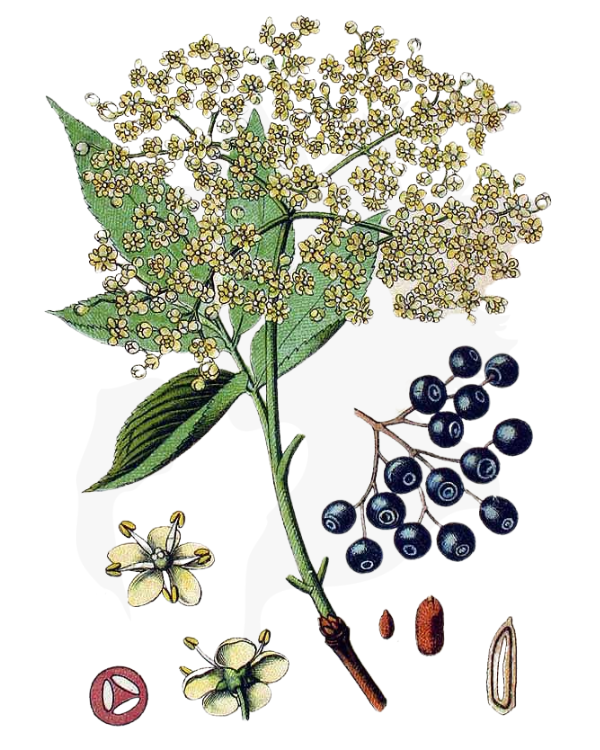
One of the most rewarding things to forage in early summer are the flowers of the Elder (Sambucus nigra) tree. The tree got its name from the Angelo-Saxon word ‘aeld’, which means “to kindle” or “fire.” It got its name because hollowed-out elderberry stems were used to blow on kindling from a safe distance.
We have covered ground elder in another post, and as the name denotes, ground elder (Aegopodium podagraria) and elder (Sambucus nigra) have some things in common, specifically the leaves.
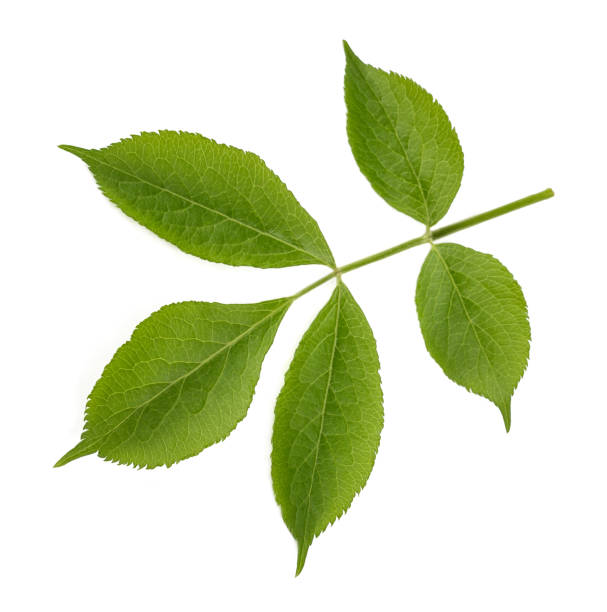
There are some differences though. The two bottom leaves of ground elder (Aegopodium podagraria) unite at the base, whereas all the leaves of elder (Sambucus nigra) are clearly separated.
Why is this important? Because ground elder leaves are edible and tasty, but elder leaves are toxic. Indeed, what we are after with elder, are the flowers and berries.
The flowers come around in June and they are very fragrant.
Medicinal uses
According to PFAF, Elder has a very long history of household use as a medicinal herb. The plant has been called ‘the medicine chest of country people’. The flowers are the main part used in modern herbalism, though all parts of the plant have been used at times. The inner bark is collected from young trees in the autumn and is best sun-dried. It is diuretic, a strong purgative and in large doses emetic and for those reasons it is used in the treatment of constipation and arthritic conditions. The fresh flowers are used in the distillation of ‘Elder Flower Water’. The flowers can be preserved with salt to make them available for distillation later in the season. The water is mildly astringent and a gentle stimulant. It is mainly used as a vehicle for eye and skin lotions. The dried flowers are diaphoretic, diuretic, expectorant, galactogogue and pectoral. An infusion is very effective in the treatment of chest complaints and is also used to bathe inflamed eyes. Externally, the flowers are used in poultices to ease pain and abate inflammation. Used as an ointment, it treats chilblains, burns, wounds, scalds etc. A tea made from the dried berries is said to be a good remedy for colic and diarrhoea. The fruit is widely used for making wines, preserves etc., and these are said to retain the medicinal properties of the fruit. The root is no longer used in herbal medicine but it formerly had a high reputation as an emetic and purgative that was very effective against dropsy.
Folklore
Elder boasts a rich folklore tradition assigned to it. Elder trees were associated with rebirth and transformation as they readily grow, even from cut branches. This idea of renewal contributed to the elder tree’s significance in rituals and celebrations related to seasonal cycles, particularly the onset of spring.
In Denmark, peasants would not cut down an elder for fear of Hyldemor, the Elder-mother, who dwelt in its trunk. This belief is also found in Eastern England. In Lincolnshire until quite recently, it was important to ask permission of the ‘Old Lady’ or ‘Old Girl’. The correct way to approach the tree was to say: ‘Old Woman, give me some of thy wood and I will give thee some of mine when I grow into a tree’. If this procedure was not adopted, ill-luck could befall. In Ireland, witches were thought to use elder boughs as magic horses, while in England the crooked-branched tree was thought to be the form of a bent old witch, who would bleed if she were cut.
The elder’s reputation went from bad to worse with a Christian legend that claimed that the crucifix was made from its wood and Judas Iscariot was said to have hanged himself on the eider. An old carol called, ‘The Twelve Apostles’ tells the story, and in the last verse denounces the elder, which stands as an outcast from the other trees.
And in Scotland, where the elder is known as the ‘bour-tree’, an old rhyme points to the tree’s small stature and crooked branches as punishment for its part in Jesus’ death :
Bour-tree, bour-tree, crookit rung,
Never straight and never strong,
Eer bush, and never tree,
Since our Lord was nailed t’ye
Culinary uses
As mentioned above, elder leaves, as well as the unripe and uncooked berries are toxic and should be avoided. That being said, thre are so many tasty things to be done with the flowers and the ripe berries.
The flowers can be dried and made into a tea, but it is much better if they are made into an elderflower cordial or elderflower syrup!
 (Fer)mental Greens