
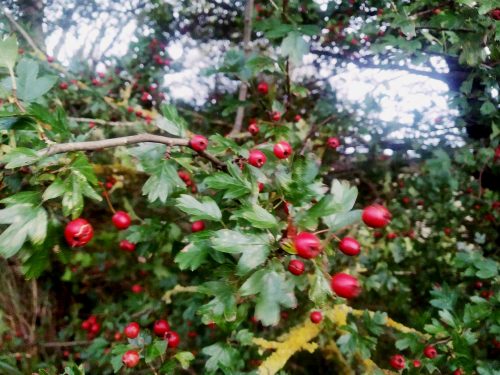
Autumn is here and you can feel it in the air, in the wet mornings, in the fallen yellow leaves becoming the mulch for the new plants to emerge from it, from the faint smell of some early and eager wood burning stoves warming their masters.
With autumn comes an abundance of wild fruits and berries and it is truly beautiful being outside in nature and soaking in the beautiful colors.
One plant that decorates hedgerows this time of the year is hawthorn, a beautiful plant that offers both its leaves and its fruits. A great plant for a novice forager as its 3-lobed leaves and bright red berries shaped like tiny apples are characteristic and not easily confused with any dangerous species.
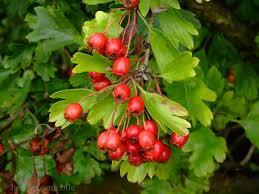
Hawthorn, otherwise known as Crataegus monogyna, mayblossom, maythorn and haw is a species of the rose family, Rosaceae. It has moderately fragrant flowers in spring and its fruits are technically pommes (like apples) rather than berries. The fruit is very important as a food source for wildlife in the winter, and especially for waxwings and thrushes.
History
Hawthorn has a rich history, one ancient specimen allegedly being the oldest tree in France. “A famous specimen in England was the Glastonbury or Holy Thorn which, according to legend, sprouted from the staff of Joseph of Arimathea after he thrust it into the ground while visiting Glastonbury in the first century AD….The oldest known living specimen in East Anglia, and possibly in the United Kingdom, is known as the Hethel Old Thorn, and is located in the churchyard in the small village of Hethel, south of Norwich, in Norfolk, UK. It is reputed to be more than 700 years old, having been planted in the 13th century.”
Medicinal
Hawthorn has been used in traditional and modern medicine as a heart tonic. It contains bioflavonoids that increase the blood supply to the heart and brain. It is used for conditions that weaken the heart, especially when partnered with high blood pressure. Both the flowers and the fruits are used in tinctures and teas for this effect.
Folklore
Hawthorn is revered s an important plant in Beltane celebrations as it brings in the spring. It is also used in pagan weddings to strengthen the relationship and in ancient Greece torches from the roots were made for marriages.
Even though it is considered lucky by some, there was significant negative superstition around bringing hawthorn flowers in the house, because the flowers “smelled like the plague”. Centuries after this practice, scientific research showed that the flowers contain Trimethylamine, a chemical that smells like decomposing bodies. The same chemical is found in bodily fluids, and specifically semen, meaning that the plant also smells of sex!
It was also used as a witch deterrent from ancient times with branches being placed in windows and cowsheds. In the Slavic cultures it was used against vampires, with stakes often made from its wood as well as branches being placed under the heads of dead people.
In Irish Celtic culture hawthorn was associated with the otherworld. It is a bush heavily associated with the fairies and entrances to the otherworld. If someone were to damage a tree they would have bad luck or accidents happen to them. A urban legend says that the Delorean company cut down a hawthorn bush to build a factory which resulted in the failing of the company, even after they replanted another hawthorn tree. Talk about superstition!
In Welsh folklore, Merlin is said to be bound in a Hawthorn tree by the witch Nimue. Hawthorn is also used for witches’ brooms and wands. “The word Hawthorn comes from the Anglo-Saxon “hagedom”, meaning hedge thorn… The word “hag”, meaning witch, shares the same origin.”
In Christian mythology hawthorn was the tree out of which the crown of thorns was made.
Culinary
Hawthorn is a very useful plant for culinary reasons. Its leaves are among the first to appear in early spring, and when gathered young, have a lovely, mild, nutty flavor that offers itself as a valuable green in salads. But the true magic comes from the berries. Rich in vitamin C, the berries can be made into jellies, jams, preserves, chutneys, teas and ketchup! Check out this recipe for hawthorn ketchup and let me know how you find it!
 (Fer)mental Greens