
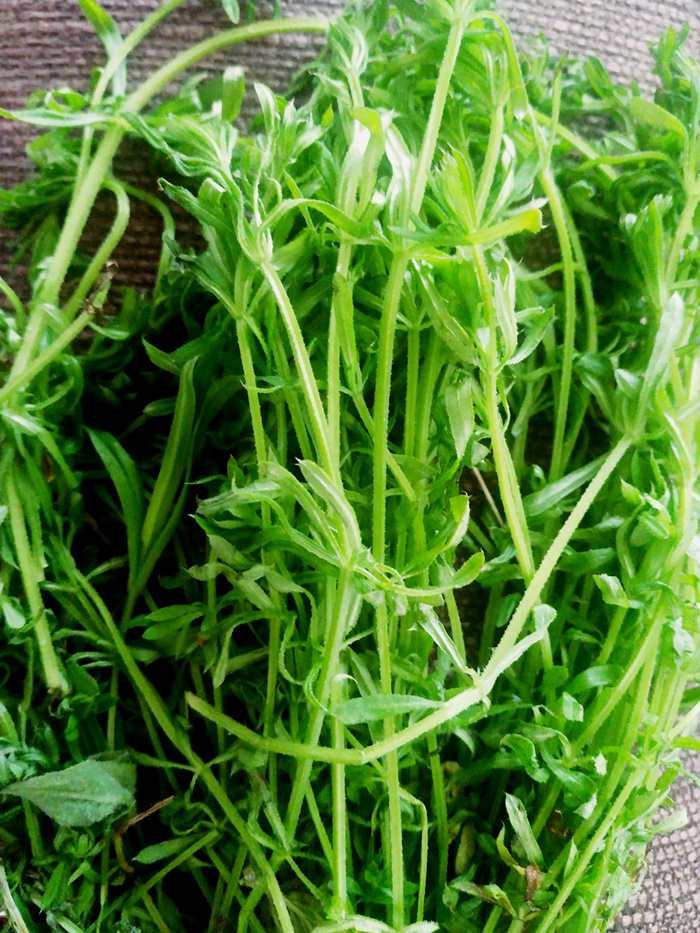
On today’s foraging walk/cycle, among many many others, I also found cleavers. This little “weed” that grows prolifically in path edges and woodlands goes by many other names such as Clivers, Goosegrass, Catchweed, Sticky Weed, Robin-Run-the-Hedge, Sticky Willy, Sticky willow, Velcro Weed and Grip Grass because of the tendency to stick to clothes due to the many tiny hooks it has.
The Latin name however doesn’t come from its stickiness but from the Greek Γάλα (Gala), which means “milk”, and Απαίρνω (aperno) which means “to seize”. The reason behind this nomenclature is that another of the same species, Galium verum, was used to curdle milk, or to “seize the milk”. How fascinating is that?
Before we continue with other interesting facts of this “weed” let’s try to identify it.
Identification:
Cleavers is a bright green plant with shallow roots. It is very easy to distinguish as it grows from late winter all the way to the summer in hedgerows and wooded areas. It has characteristic little hooks that make it attach on clothes, granting it its name of sticky willy.
Medicinal
This little plant has some very interesting medicinal properties and has been used for thousands of years in different cultures. It is a diuretic, helps with skin conditions and detoxifies the body during cancer treatments. Dioscorides used cleavers for tiredness while Galen prescribed it for obesity. Native American Indians used the herb to treat gonorrhoea.
Other uses
A red dye can be obtained from the roots that can be used to dye food and bones, and it is said that poultry fed on the roots will have a slight red tinge in their bones. The ancient Greeks used to make a makeshift sieve using cleavers, to filter milk.
Folklore
Farmers encouraged growth of the plant because geese are extremely fond of the herb, hence the name ‘goosegrass’. It was also said that a lady’s locks would grow strong and long, if they rinsed their hair with an infusion of goosegrass. The infusion was also used in baths to ensure success in affairs of the heart.
Culinary
Cleavers has a very light and refreshing taste, a bit like cucumber and peas. It can be infused in water or made into a detoxifying juice but personally I love blanching them and serving them with a tiny bit of vinegar and salt. They work well as a salad, especially if young and tender, and can be used as a basic green in stir fries. The seeds can also be roasted, ground and made into a coffee substitute.
 (Fer)mental Greens
Can you use it to make cheese?
LikeLike
I have never tried with Galium aparine but Galium verum was used to make cheese, yes. It’s a good experiment to keep in mind 🙂
LikeLike